
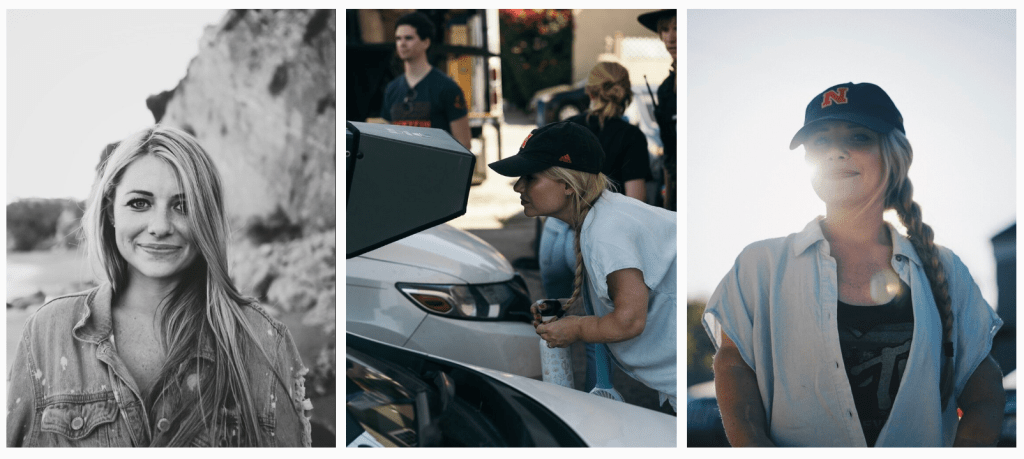
It was 2018 when I was searching for personalities who are inspiring in a very special way. By chance, and without specifically looking for anything, I came across a video on the SoulPancake platform. On the screen, I see a woman saying the following sentence:
I am just a human and one day this body is gonna be gone.
Ashley Eakin, Filmmaker
It is Ashley Eakin who articulates this sentence. The video is a feature. A video that gives extraordinary people the opportunity to be seen. The company itself advertises with the following sentence: “The Interweb’s GOAT source for uplifting videos about what it means to be human.” At SoulPancake, the focus is on people – people who are real, unfiltered and have a story to tell.
I have decided to publish this interview as a modern 2026 feature, and not as a simple Q&A blog post – so, the interview with Ms. Eakin is a narrative, reflective blog piece that reintroduces my conversation with Ms. Eakin in a way that feels current, layered and culturally relevant. Enjoy!
THE MIRROR MOMENT
Ashley was born with a rare combination of Ollier’s Disease and Maffucci Syndrome – a non-genetic condition that affects bone growth and can lead to tumors, surgeries, and lifelong medical challenges. By 2018 when our interview took place, she had undergone +25 surgeries and survived ovarian cancer twice.
This facts show that Ashley had gone through difficult times. I still remember the medical complexity as well as something else.
She desribed walking through her life feeling “normal” – until she caught her reflection in a mirror. She says:
“So, growing up I think I really tried to push the disease aside and almost ignore it. But as I matured and was able to process my disease, I have realized it has infiltrated every aspect of my life. In both good and bad. Growing up, I used to avoid mirrors because when going about daily life, I would think I had the standard body – like what I see on everyone around me, but then I would catch myself in the mirror or see a photo and remember, OH! I am different and it would almost have this devastating effect. But with each passing year, I have grown to love myself but the most dramatic shift probably happened around 2012, with the most prominent growth happening this past year“.
That moment – the collision between self-perception and external reality might probably be something many of us understand. Whether medically influenced or not, many people might be familiar with “The Mirror Moment”.
The mirror is not only glass anymore.
It is Instagram.
It is TikTok.
It is AI-enhanced perfection.
It is society.
Ashley continues:
“Do not get me wrong, although I have had internal struggles with my disease – people who know me would describe me as happy and fun. I have not let my disease hold me back from pursuing my goals and I have had some amazing jobs in TV and Film that have allowed me to travel the world. Aside from a small group of people, most people who know me think I own who I am and this disease, which is true. But it is definitely been a journey to get here. I never in my life thought I would be this open on the internet. Even if you asked me two years ago, I would have never thought I would be this vulnerable.“
Ashleys’s realization that “normal” body would not equal a perfect life dismantles one of the most persistent illusions of our time: that appearance determines fulfillment.
VULNERABILITY
When Ashley decided to publicly share her story, she called it her “coming out” moment — not in the traditional sense, but in the sense of revealing what had long been hidden.
She wore a dress that showed her scars. She chose not to hide.
“I never thought I would be this vulnerable online,” she told me.
In 2018, vulnerability on the internet felt brave and unusual. But it is people like Ashley who have paved the way.
In 2026, vulnerability is everywhere – That is important. It is necessary.
But there is a difference between curated vulnerability and courageous vulnerability.
Ashley’s story was not aestheticized. It was not monetized trauma. It was a woman deciding, on her own terms, to exist fully — scars included.
That distinction matters.
BEYOND THE BEAUTIFUL FACE
Ashley revealed that some people reduce her appearance to her beautiful face. “It’s weird,” she said. “It’s a compliment. But it feeds into the idea that if I had a ‘normal’ body, my life would be perfect.”
Ms. Eakin opens up an important topic which people with disabilities unfortunately face. That sentence quietly dismantles ableism, perfectionism, and surface-level empowerment narratives all at once.
This is what Ashley’s case reveals :
Beauty can become a mask.
Compliments can become cages.
And assumptions can erase complexity.
That means, in a culture still obsessed with visual capital, Ashley reminds us that a person is not a highlight reel.
CHOOSING MAGIC – EVEN IN PAIN
What I loved during our interview is that Ashley does not romanticize suffering.
She acknowledges her pain. She acknowledges her struggles. She admits that she could focus on the negative — and it would be just as truthful.
But she chooses something else:
I do see a positive purpose. But I really have to focus on that. I could easily focus on the negative and it would be just as truthful. But I think, at the end of the day, you take away what you want. And I choose to live a life where I see magic all around us, even in pain and tragedy. Empathy is one of the most beautiful characteristics of human beings and I get to see that all the time.
Ashley Eakin
That choice is not naïve optimism. It is agency.
In 2026, where cynicism often masquerades as intelligence, choosing empathy can feel like rebellion.
And empathy, as Ashley says, is one of the most beautiful characteristics of human beings.
REPRESNTATION AND STORYTELLING
Ashley never wanted her entire creative identity to revolve around her illness. She wants to direct powerful stories — stories that connect, stories that move people, stories that expand perspectives.
That desire feels even more relevant today, as conversations about disability representation, authentic casting, and inclusive storytelling reshape the film industry.
Her journey is not just about overcoming something.
It is about who gets to tell stories.
Who gets to direct them.
Who gets to be seen.
KINDNESS IS NOT INHERENT – IT IS LEARNED
When I asked Ashley what she would wish for, one of her answers was simple:
“For people to be more kind.”and added something that still echoes today:
Hate and cruelty is not inherent. It is learned.
Ashley Eakin
She added:
“SO MANY THINGS! This video went out and I contemplated a documentary, because I love stories and have heard from so many incredible people pouring their souls out. And I thought about going around and meeting these people – but truly, I do not know if I want my creative filmmaking focus to be on my own life. If the opportunity arose, I may chase that – but my main goal is to direct powerful stories that people can connect to. Not only about my own disease. I have directed a few short films and my most recent one I shot in Malaysia this summer. It is called The Details and it is really special to me. I am excited to release it soon!
For my next project, I also have as short film that is inspired by one of my favorite Shel Silverstein poems called Masks. I plan to fundraiser for it and may even include some of the people who have reached out to me through the video. It is going to be a good one!“
In an era defined by polarization and digital hostility, that insight feels less like a wish and more like a call to action.
Kindness is not passive.
It is cultural work.
WHY THIS CONVERSATION STILL MATTERS
Looking back at our 2018 conversation, it was never just about illness.
It was about identity.
About visibility.
About the courage to exist without apology.
Ashley taught me that self-confidence is not a destination. It is a practice. A daily decision to focus on what is internal rather than external. To value empathy over aesthetics. Purpose over perfection.
And perhaps that is why this interview feels even more relevant today.
In a world obsessed with being seen, Ashley reminds us that the real work is in being whole.
ABOUT ASHLEY EAKIN:
Name: Ashley Eakin
Born: California
Profession: Filmmaker, Director and Advocate
Known for: Films like Single, Growing Up, Forgive Us Our Trespasses, Survive, Crazy Rich Asians
ALSO WORTH READING:
Ashley’s reflections join a chorus of voices I have previously highlighted — voices like Najwa Zebian’s, Kathy Parker’s and Funmilola Fagbamila’s — women who transform personal experience into collective impact.
 abylovesblogging.com