
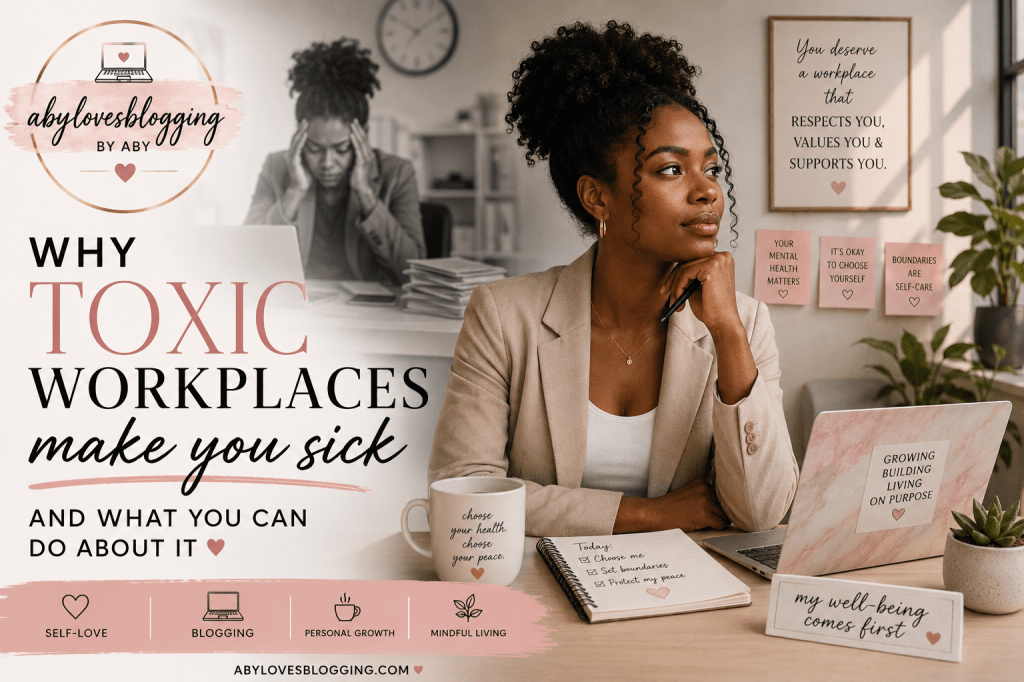
WHY LEAVING TOXIC, HIGH-STRESS ENVIRONMENT MATTERS MORE THAN WE ADMIT

Picture generated with AI

There is a common belief that stress is just part of life – something to tolerate, push through, and eventually adapt to. But there is a difference between ordinary pressure and environments that keep the mind and body in a prolonged state of strain.

High-stress environments are not only mentually exhausting. They often reveal themselves quite clearly early on – but the signals can be easy to overlook, especially when you are focused on doing your job, meeting expectations, or simply trying to adjust.

Over time, though, the cost of staying becomes harder to ignore.

1. TOXIC ENVIRONMENTS OFTEN REVEAL THEMSELVES EARLY

Unhealthy work environments rarely stay hidden for long. Patterns tend to appear quickly:

  • emotionally unpredictable dynamics
  • ongoing tension or blame culture
  • shifting expectations
  • unprofessional behaviour, such as belittling and humiliation
  • the feeling to never be enough

In hindsight, many people realize the signs were visible from the beginning. The challenge is often not awareness – it is what to do with that awareness when you need the job.

2. CHRONIC STRESS CHANGES HOW YOUR MIND WORKS

The human nervous system is built for short burts of stress, not constant pressure. When that balance is lost, the body can remain in a prolonged state of alert.

This shows up as:

  • difficult concentrating or staying grounded
  • emotional overwhelm or numbness
  • presistent anxiety or instability
  • mental fatique that does not fully resolve

In some cases, panic responses can become more frequent or intense when there is no real recovery space stressors.

3. THE BODY CARRIES WHAT THE MIND ENDURES

Stress does not stay contained in the mind – it shows up physically as well.
Sleep becomes lighter, energy drops, and the body feels like it is constantly trying to catch up on recovery.

During prolonged exposure to high-stress envirnments, some people also notice significant health changes emerging. Even the relationship between stress and health is complex, the timing often raises difficult but important questions.

4. TOXIC ENVIRONMENTS SLOWLY RESHAPE WHAT FEELS NORMAL

One of the most subtle effects is normalization. Humans adapt to their surroundings – even when those surroundings are unhealthy.

What once felt alarming can gradually become routine:

  • constant pressure without relief
  • lack of emotional safety
  • ongoing instability or tension
  • living in a near-constant state of alterneess

Over time, the question shifts from “Why is this happening?” to “Why I am not coping better?

5. SURVIVAL MODE TAKES UP MORE SPACE THAN YOU REALIZE

When most energy goes into coping, there is less left for everything else – creativity, relationships, rest, and long-term thinking.

Many people only realize how depleted they were once they are no longer inside that environment and begin to feel clarity and energy return.

6. SOMETIMES LEAVING HAPPENS BEFORE YOU FEEL READY – AND THAT MATTERS

Not everyone gehts to choose the timing of leaving a toxic environment. Sometimes change arrives externally rather than through a personal decision.

In hindsight, that separation can bring unexpected clarity. There are moments when you realize you were already mentally and emotionally on the way out long before anything changed officially. In that sense, the exit can feel less like a disruption and more like alignment with something you already knew internally – that staying longer would not have been sustainable.

7. DISTANCE BRINGS CLARITY

With space, it becomes easier to see patterns that were hard to name in the moment:

  • chronic stress vs. normal pressure
  • adaption vs. well-being
  • endurance vs. health

8. LEAVING IS NOT ALWAYS IMMEDIATE – BUT AWARENESS MATTERS

Not everyone can leave quickly. Financial dependence, responsibilities, or uncertainty can delay action.

But awareness still changes things. It creates room for:

  • boundaries
  • planning an exit
  • reducing exposure where possible
  • taking internal signals seriously

Even small shifts can reduce harm while larger decisions take shape.

CLOSING THOUGHTS

Toxic, high-stress environments often do not hide – they reveal themselves early. The difficulty is not always them, but trusting what you see and acting on it in time.

Not all stress is harmful, but chronic strain can quietly affect both mental and physical well-being in ways that are easy to miss while you are inside it.

And sometimes, what feels like an external interruption – like a layoff or forced separation – can later be understood as removing you from something you were already ready to leave, even if you had not fully admitted it yet.

Leaving is not just about escaping pressure. It is about stepping out of a system that requires constant adapting just to get through the day – and returning to a state where stability and recovery are possible again.


The environment I found myself in brought back panic attacks that I had not experienced in years. Sleep became difficult. Insomnia became a part of my routine. Over time, I also faced serious health challenges that forced me to confront a reality: NO JOB IS WORTH SACRIFICING YOUR HEALTH FOR! Especially when racism goes unpunished in any way.


HOW TO NAVIGATE:

  • Understand that chronic stress changes your baseline
  • Stop normalizing “endurance” as a virtue
  • Watch for identity shrinkage
  • Your body knows before your mind admits it
  • Distance restores perspective faster than analysis
  • Recovery is part of the decision, not a reward
  • Do not wait for the environment to “prove” it is toxic

MINUSCH AFONSO: FIGHTER, WARRIOR, BREAST CANCER SURVIVOR

Minusch Afonso by © Max Sonnenschein

Imagine you want to spend a nice day by the lake with a friend, enjoying some quality time, and this day later turns out to be fateful. This is what happened to Minusch Afonso in 2021. Minusch Afonso is a journalist, moderator, and host in Bavaria and originally from Angola. I meet Minusch Afonso in April at my apartment in Munich to talk about that fateful day in her life. Even before the interview, I knew this conversation would be special. Not only because of the topic, but because Minusch is one of those people you find immediately likable. Here is the story of a breast cancer survivor, which aims to provide insight into what many cancer patients go through and inspire people not to give up. Thank you Minusch for your time, courage and openness!


1. Tell me about this fateful day? What kind of day was it?

Minusch: I had some discomfort in my lower abdomen that day, so I went to see a gynecologist. I was examined, prescribed medication, and everything seemed fine. I then went to the Isar River with my friend for some food and later went home. At home, I ordered some food, and when the delivery guy arrived, I opened the door. For no apparent reason, I pointed my index finger towards my breast and touched it. Just like that. It made no sense. The spot was not itchy or anything, but I just touched that spot. And then I felt a small lump and thought, “Huh, what is that?” I googled it, and usually, Google brings up really scary things, but in this case, it did not.Then, I watched a video on YouTube about how to properly examine breasts and recognize signs of breast cancer. None of the symptoms described in the video matched what I was experiencing. Sometimes, it mentioned discharge from the nipple or skin that looks like an orange peel, but I did not have any of that. So, I thought, okay, maybe it is nothing. On the other hand, I was wondering if I should go to the gynecologist again the next day, considering I had already been there. Then, I remembered I had a doctor’s appointment in Saarbrücken in two weeks and decided to bring it up then.

@abylovesblogging: Minusch went to her see her doctor and told her about her concerns and the lump she had discovered.

Minusch: I attended the appointment in Saarbrücken and told the doctor that I had felt something in my breast. She assured me it was probably nothing serious but examined the area. Having worked in a breast cancer center for many years, she was quite confident it was not anything to worry about. However, to put my mind at ease, she decided to investigate further. I had another appointment where they numbed my breast and used a long instrument to take samples from the tumor. Afterwards, I was allowed to go home. I felt conflicted and another week passed before I was supposed to call for the results.

@abylovesblogging: As if the situation was not difficult enough, Minusch had to wait for the test results. In the interview, she told me that the waiting was the worst part for her. The next day, her life changed from one day to the next.

Minusch: So, I called the next day, and they told me the result was in, and the doctor would call me later – that is when I knew something was wrong. I waited for 1.5 hours for her to call back. Those 1.5 hours were terrible because I had no idea what was going on. When the doctor called, she told me that, unfortunately, it was not as she initially thought and that the diagnosis was malignant. At that moment, everything stopped for me – I was in shock, genuinely shocked. I thought I was going to die. That was my first thought because there had never been any cancer cases in my family. Not even in my circle of friends. The only things I knew about cancer were from TV.

2. What did you do when you realised you had breast cancer?

Minusch: I called my mom and talked to friends who tried to calm me down. My mom drove from Freiburg to be with me. I really appreciated how calm she was because she usually is not that calm. Her calmness helped me stay calm, and we got through that time together. That evening, my mom and I prayed. Eventually, I went to see my gynecologist with her, and the journey felt like it took forever. In the clinic, we had to wait about 45 minutes, and the assistants looked at me with such pity because I kept going to the bathroom due to my nerves. Finally, a doctor came and said that the gynecologist had asked him to talk to me. [Minusch never saw this gynecologist again, despite repeatedly trying to reach her.] The doctor only asked me what questions I had for him.

I had the feeling as if my soul is leaving my body.

Minusch Afonso

@abylovesblogging: Once it was certain that Minusch had breast cancer, they went to the doctor and underwent examinations. She was referred to the breast centre and had to undergo various examinations such as ultrasounds, blood tests and mammograms.

3. What could have gone better on the way to your chemotherapy?

Minusch: Communication during this phase was not always clear. The thing which was so unfortunate about the doctors was that they never spoke plainly. I did not just have to deal with one doctor but with different ones and each of them said different things. That was a bit difficult.

@abylovesblogging: Although the doctors almost always assured Minusch that she did not need chemotherapy, after the surgery, it was recommended by various experts that she undergo chemotherapy.

Minusch: I took all my documents to this doctor and asked him for help. He took his time—two hours, to be exact. He explained everything to me, step by step. He also told me that I had a good chance of recovery because the tumor had not spread to the lymph nodes. Given that I got cancer at such a young age, he advised me to have a genetic test to understand the origin of the cancer. Additionally, he explained the step of mastectomy and recommended that I undergo chemotherapy anyway because I am so young. I could write to this doctor on WhatsApp if I had any questions, and that is still the case. Even though it took some time for me to trust him, I must say he did a good job.

@abylovesblogging: With her thoughts focussed on the forthcoming chemotherapy, Minusch was unfortunately given more bad news…

Minusch: One day before the chemo, I received the news that I do suffer from a rare genetic defect. My first chemo started on December 20, 2021. Normally, the chemo should last about four months, but since I did not tolerate the chemo well (poor blood values, feeling of fullness, fatigue, nausea, fatigue, and vomiting), it ended up being eight months.

I did not expect that at all

Minusch Afonso
Minusch Afonso by ©  Vera Johannsen

4. Who were you able to count on in particular during this time?

Minusch: My family was there for me and helped me as much as they could. My friends too, of course. Some of them called me via Facetime, spoke to me on the phone and tried to build me up. That was really nice to see.

5. Were you also able to draw positive things from your illness?

Minusch: Yes, very many… I had a lot of time to reflect on myself. I would say that I used to be a people pleaser and was always concerned about how others were feeling. But the illness showed me that there is only one Minusch, and there is no second, so I need to take care of myself. That is why I also learned to set boundaries, say no, and stand up for myself. If I notice something is not good for me, I now take immediate action. I was not like that before. I used to beat around the bush, procrastinate, and make excuses for people. I do not do that anymore. I do not have time to get upset because life is short. My friendships have also become closer, and I have cut some people out of my life because some friendships were toxic. Not that you would define these friendships as toxic at first glance. They were the kind of friendships that drain your energy or involve people who constantly complain. I was not aware before that such things or people were dragging me down. Cutting these people out of my life has given me so much balance. I can hardly believe it, but I have never felt so balanced in my life. Those unconscious stress factors are no longer there.

6. How has the illness changed your relationship with God?

Minusch: I have come much closer to God. I remember when I had trouble sleeping at the beginning, I called the crisis hotline, and the staff there prayed with me over the phone, which I found very comforting. They also sent me a small book about the church and Jesus. During that time, I read a lot from the Bible, even passages I did not know before… For example, I was already familiar with Psalm 120, but during that period, I read it very often because it fit my situation. I also frequently spoke with the pastoral counselor…The day I found out that I would need chemotherapy, I was angry. But I wanted to wait and see what would happen…I realized that God is always there and looking out for me. Even if it was a terrible situation, He is there the entire time. He has not left me alone. I thought about other situations in my life. Situations that were incredibly bad, where I was always supported. I was sad and angry, but the solution was always just around the corner.

7. If you had 3 wishes, what would you wish for?

Minusch: I would wish for better weather, good health and to have a beautiful and fulfilling life.

8. What tips do you have for people who are in the same or a similar situation as you were back then?

Minusch: I would also advise against googling or following certain Instagram profiles, as everyone has their own individual diagnosis. Secondly, request a consultation with doctors. And lastly, accept help. Admitting that you are ill. People often associate cancer patients with the verb ‘strong’ and I have the feeling that patients try to fulfil this. But you are ill and have cancer – that is not a cough. You can be ill and do so with a clear conscience. For example, I felt guilty about my work colleagues because I thought to myself: ‘Shit, now I cannot go to work’, but when you are ill, that is the way it is. You are allowed to be sick and recover and take the time you need and get fit. I stressed myself out to get fit again and put myself under pressure.


Find Minusch Afonso on Instagram: https://www.instagram.com/minusch_afonso/

Give abylovesblogging a Like and a Follow on Instrgram: https://www.instagram.com/abylovesblogging/

Support DKMS Germany and become a stem cell donor (Germany): https://www.dkms.de/

Support DKMS USA and become a stem cell donor (US): https://www.dkms.org/

Study on Breast cancer in Germany: https://pubmed.ncbi.nlm.nih.gov/38702333/