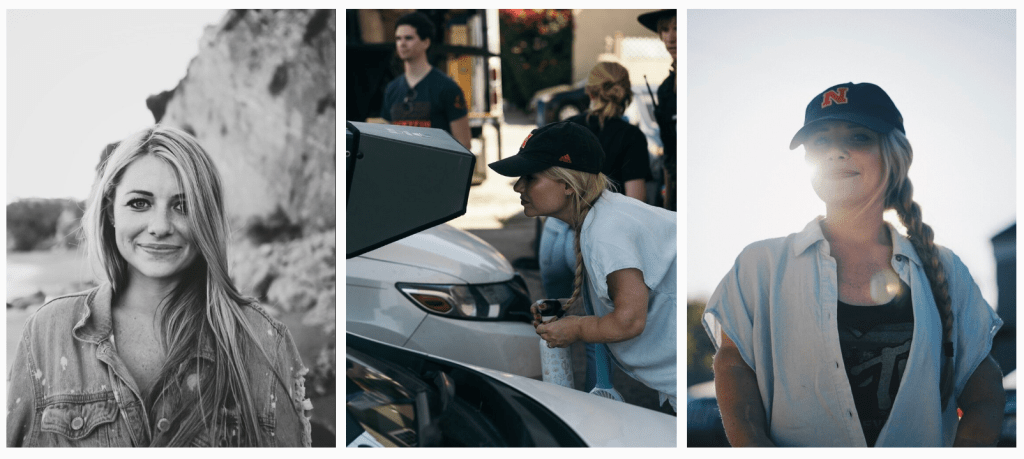
ASHLEY EAKIN ON DISABILITY, BEAUTY AND STORYTELLING: WHY HER VOICE MATTERS

© Ashely Eakin / Offcial Website of Ashley Eakin

It was 2018 when I was searching for personalities who are inspiring in a very special way. By chance, and without specifically looking for anything, I came across a video on the SoulPancake platform. On the screen, I see a woman saying the following sentence:

I am just a human and one day this body is gonna be gone.

Ashley Eakin, Filmmaker

It is Ashley Eakin who articulates these sentence. The video is a feature. A video that gives extraordinary people the opportunity to be seen. The company itself advertises with the following sentences: “The Interweb’s GOAT source for uplifting videos about what it means to be human.” At SoulPancake, the focus is on people – people who are real, unfiltered and have a story to tell.

I have decided to publish this interview as a modern 2026 feature, and not as a simple Q&A blog post – so, the interview with Ms. Eakin is a narrative, reflective blog piece that reintroduces my conversation with Ms. Eakin in a way that feels current, layered and culturally relevant. Enjoy!


THE MIRROR MOMENT

Ashley was born with a rare combination of Ollier’s Disease and Maffucci Syndrome – a non-genetic condition that affects bone growth and can lead to tumors, surgeries, and lifelong medical challenges. By 2018 when our interview took place, she had undergone +25 surgeries and survived ovarian cancer twice.

This facts show that Ashley had gone through difficult times. I still remember the medical complexity as well as something else.
She desribed walking through her life feeling “normal” – until she caught her reflection in a mirror. She says:

So, growing up I think I really tried to push the disease aside and almost ignore it. But as I matured and was able to process my disease, I have realized it has infiltrated every aspect of my life. In both good and bad. Growing up, I used to avoid mirrors because when going about daily life, I would think I had the standard body – like what I see on everyone around me, but then I would catch myself in the mirror or see a photo and remember, OH! I am different and it would almost have this devastating effect. But with each passing year, I have grown to love myself but the most dramatic shift probably happened around 2012, with the most prominent growth happening this past year“.

That moment – the collision between self-perception and external reality might probably be something many of us understand. Whether medically influenced or not, many people might be familiar with “The Mirror Moment”.
The mirror is not only glass anymore.

It is Instagram.
It is TikTok.
It is AI-enhanced perfection.
It is society.

Ashley continues:

Do not get me wrong, although I have had internal struggles with my disease – people who know me would describe me as happy and fun. I have not let my disease hold me back from pursuing my goals and I have had some amazing jobs in TV and Film that have allowed me to travel the world. Aside from a small group of people, most people who know me think I own who I am and this disease, which is true. But it is definitely been a journey to get here. I never in my life thought I would be this open on the internet. Even if you asked me two years ago, I would have never thought I would be this vulnerable.

Ashleys’s realization that “normal” body would not equal a perfect life dismantles one of the most persistent illusions of our time: that appearance determines fulfillment.

Ashley Eakin on SoulPancake – I Survived My Greatest Fear

VULNERABILITY

When Ashley decided to publicly share her story, she called it her “coming out” moment — not in the traditional sense, but in the sense of revealing what had long been hidden.

She wore a dress that showed her scars. She chose not to hide.
“I never thought I would be this vulnerable online,” she told me.

In 2018, vulnerability on the internet felt brave and unusual. But it is people like Ashley who have paved the way.
In 2026, vulnerability is everywhere – That is important. It is necessary.
But there is a difference between curated vulnerability and courageous vulnerability.
Ashley’s story was not aestheticized. It was not monetized trauma. It was a woman deciding, on her own terms, to exist fully — scars included.

That distinction matters.

BEYOND THE BEAUTIFUL FACE

Ashley revealed that some people reduce her appearance to her beautiful face. “It’s weird,” she said. “It’s a compliment. But it feeds into the idea that if I had a ‘normal’ body, my life would be perfect.”

Ms. Eakin opens up an important topic which people with disabilities unfortunately face. That sentence quietly dismantles ableism, perfectionism, and surface-level empowerment narratives all at once.

This is what Ashley’s case reveals :

Beauty can become a mask.
Compliments can become cages.
And assumptions can erase complexity.

That means, in a culture still obsessed with visual capital, Ashley reminds us that a person is not a highlight reel.

CHOOSING MAGIC – EVEN IN PAIN

What I loved during our interview is that Ashley does not romanticize suffering.

She acknowledges her pain. She acknowledges her struggles. She admits that she could focus on the negative — and it would be just as truthful.

But she chooses something else:

I do see a positive purpose. But I really have to focus on that. I could easily focus on the negative and it would be just as truthful. But I think, at the end of the day, you take away what you want. And I choose to live a life where I see magic all around us, even in pain and tragedy. Empathy is one of the most beautiful characteristics of human beings and I get to see that all the time.

Ashley Eakin

That choice is not naïve optimism. It is agency.
In 2026, where cynicism often masquerades as intelligence, choosing empathy can feel like rebellion.

And empathy, as Ashley says, is one of the most beautiful characteristics of human beings.

REPRESNTATION AND STORYTELLING

Ashley never wanted her entire creative identity to revolve around her illness. She wants to direct powerful stories — stories that connect, stories that move people, stories that expand perspectives.

That desire feels even more relevant today, as conversations about disability representation, authentic casting, and inclusive storytelling reshape the film industry.

Her journey is not just about overcoming something.

It is about who gets to tell stories.
Who gets to direct them.
Who gets to be seen.

KINDNESS IS NOT INHERENT – IT IS LEARNED

When I asked Ashley what she would wish for, one of her answers was simple:

“For people to be more kind.”and added something that still echoes today:

Hate and cruelty is not inherent. It is learned.

Ashley Eakin

She added:

SO MANY THINGS! This video went out and I contemplated a documentary, because I love stories and have heard from so many incredible people pouring their souls out. And I thought about going around and meeting these people – but truly, I do not know if I want my creative filmmaking focus to be on my own life. If the opportunity arose, I may chase that – but my main goal is to direct powerful stories that people can connect to. Not only about my own disease. I have directed a few short films and my most recent one I shot in Malaysia this summer. It is called The Details and it is really special to me. I am excited to release it soon!
For my next project, I also have as short film that is inspired by one of my favorite Shel Silverstein poems called Masks. I plan to fundraiser for it and may even include some of the people who have reached out to me through the video. It is going to be a good one!

In an era defined by polarization and digital hostility, that insight feels less like a wish and more like a call to action.

Kindness is not passive.
It is cultural work.

WHY THIS CONVERSATION STILL MATTERS

Looking back at our 2018 conversation, it was never just about illness.

It was about identity.
About visibility.
About the courage to exist without apology.

Ashley taught me that self-confidence is not a destination. It is a practice. A daily decision to focus on what is internal rather than external. To value empathy over aesthetics. Purpose over perfection.
And perhaps that is why this interview feels even more relevant today.
In a world obsessed with being seen, Ashley reminds us that the real work is in being whole.

ABOUT ASHLEY EAKIN:

Name: Ashley Eakin
Born: California
Profession: Filmmaker, Director and Advocate
Known for: Films like Single, Growing Up, Forgive Us Our Trespasses, Survive, Crazy Rich Asians


ALSO WORTH READING:

Ashley’s reflections join a chorus of voices I have previously highlighted — voices like Najwa Zebian’s, Kathy Parker’s and Funmilola Fagbamila’s — women who transform personal experience into collective impact.

SILKE SZYMURA – DEATH HAS TAUGHT ME TO LIVE

© Silke Szymura
© Silke Szymura

– Couple of months ago, I came along and read on Facebook about what Silke is writing about. After I read her blog, I was sure that she would suit to my interview partners. Silke lost her partner Julian during a visit in Nepal. She uses her experience to support others during the process of grief. Read the whole interview below.

Q: Please, introduce yourself to my followers…

A: Yes, I would love to. My name is Silke and I am 35 years old. I live near Frankfurt, Germany. I am an author, blogger and grief counsellor – and at the same time, I am just me. A woman who is searching her place in this world and who does not (suit) into this world anymore, at least not like in the past. Before the death of my spouse, I was a computer scientist and worked for several companies. Nowadays, my deepest concern is to provide support for people and to contribute to find their own way through grief. This means, I am a kind of a friend from the starting point of grief. I was able to make peace with the past and now I want to pass it on.

Q: The reason why I have chosen you to be my next interview partner is that you do something really special – you blog about death and grief. Please, tell me how did you come to do that?

A: Funny, how you highlighted it as “something really special”. For me, it has become something normal. Sometimes, I must remind myself that death and grief are still taboo subjects – and that is exactly the reason why I have started to write about these issues. I have experienced how tough it is to deal with these issues. Back then, I did not know how to handle it and I remained silent and kept myself out of the way of people who were grieving. I thought it would be good not to talk about it and I thought it would be wrong to remind them of grieving. It was just an issue I could not deal with. Then, my boyfriend died, and I experienced it from another point of view. It was so painful to be alone with all that. I came to know that people who also were grieving, felt the same as I did. They told me that their friends withdrew themselves and that they were expected to grieve in  quick and in silence. Hence, it was a wish of mine to talk more about this stuff, to draw attention to grief – and what grief really means. Particularly, grief is a valuable ability of our soul to deal with loss. Grief is individual and needs time. I wanted to create a „room” where grief is allowed and to contribute to a normal handling with such an issue in Germany. It is a fact that death belongs to our lives, if we want it or not. I for myself have experienced that it becomes easier when we accept it and deal with it, instead of acting as if death does not exist. The idea to start a blog arose on all these grounds. The title “In lauter Trauer “(engl.: In loud mourning) arose from the condolence cards labelled with “In stiller Trauer” (engl. In silent mourning), which are common in Germany. I have always felt that the person who gets the card, should mourn in silence in order not to “disturb” someone. In the course of time, I have realized that it is important for me that I create some kind of a room, where feelings are welcomed. The fact that I am honest with my feelings while writing my blogposts, I also invite my readers to realize and to be honest with their feelings too. To feel them and to express them.

Q: Your partner Julian died 5 years ago. Tell me more about his death…

A: There is a lot to tell about, but at the same time, there is not that much which I can tell you. Julian fainted suddenly during our holiday in Nepal, at the age of 29. He was well just a minute ago, he was healthy and alive and in the next moment he lay on the street and died. Without any reason. We were both on the way in the morning. Therefore, I stand next to him and could not do anything to save him. I could only watch it happening. Even though, people helped us to get him to a hospital, but it was just too late. At this moment, I lost the ground, and nothing was like it was before. Days and weeks after Julian’s death, I experienced a lot of support and a lot of things which I was grateful for. Back then, we were visiting a wonderful family. Julian and I supported an association from Germany, which helps poor children and that family helped those children locally. The family treated us like a member of the family, I really felt human closeness and a deep sympathy. I was supported in Nepal. On my viewpoint, I experienced a normal handling with death, which I have never experienced before in Germany or rather never experienced in my own family. In a Buddhist monastery, it was me who inflame the wood for the cremation of his body. In these hours, I felt close to him as never before and I dipped into this feeling of love. I think, these moments were the most touching of my life right at the centre of all that pain. His death and everything what happened afterwards, have changed my life completely. For a long time, I felt like I was displaced. I lost my beloved Julian; my view of life was destroyed, and my house of cards collapsed and I did not know what to believe in anymore.

Q: How did you work through all that trauma? What did you do? Who helped you?

A: I took a lot of time for myself. This was the most important thing for me. Time to mourn Julian. But, also time to find out who I was and what my purpose in this world.  It was important for me to feel all kind of emotions which were hidden inside me. And of course, the pain which I thought I could not stand any longer. I went through this pain and hoped to come out with a new courage to face life. As I said, it was a long journey. I looked for support: therapist, hospital stay, grief counselling, grief groups, some exchange with other concerned people, with specialist literature and experience reports. And finally, support through my spiritual way of living, which began in Nepal. It was this experience, which had given me so much strength. And there was the love for Julian, our remaining connection through our soul which kept me going. My parents accommodated me which allowed me to start a professional re-orientation. Besides that, I always have met people which were just there for me. Friends accepted me the way I am although I knew was changing. I have just met the right people at the right time.Last but not least, writing helped me. Page after page, I wrote to Julian in my diary. The nature also helped me. At some point, I started to go out into the nature and tried to connect with the earth. So, there were little and big steps which helped me. Today, I am very grateful that I was able to take some time off, in order to feel and to find my peace on earth.

Q: How did you get the idea to write a book about this topic?

A: I knew that I am going to write a book about my experience, when I was on my way back home from Nepal to Germany after Julian died. I cannot say why exactly I felt that way, but I knew I have to tell this story. I knew there was a hidden message and this message wanted to be told to the world. I did not know what exactly this hidden message was or how to write a book and if someone would ever read it, but I knew I was going to write about it. It took 4 years until I took this idea into practice. My book was published under the heading “Zwischen den Welten” by MASOU-Verlag. The moment I held my first book in my hands was very special and I probably will never forget it. 

Q: What would you advise people who currently going through the same situation?

A: I would wish them to take as much time as they need and to listen to themselves. Grief knows the way and it helps us to endure this unbelievable loss. Step by step. I wish everyone who experiences grief that s/he treats her-/himself well. Grief is a tough time and it is absolutely okay when you are not okay after few months, but it is also okay vice versa. There is no right or wrong through the process of grief. It is okay when it takes time and it does not matter what other people think when we speak about grieving.

Q: Do you think Julian’s death has although a positive aspect? If yes, in which way?

A: Meanwhile, I really think and feel that his death has a positive aspect. I have experienced so great things and my life has become wealthier, simply on the fact that I know more about death and the encounters with beautiful people who I have met since his death. Julian’s death has directed me on my way, which I would not have walked on without him. This does not mean that it was a good thing that he died, but it means something valuable out from it and I am really thankful for that. 

Q: In which way did your life change, since the death of Julian?

A:  I would say that his death has changed me at all levels. Everything has changed. I am not the Silke who I was before, and I would not want to be that Silke anymore. I gave up my job as a computer scientist and explored writing. Nowadays, I work with people and I have the feeling that my work really suits to the person I am now. At the same time, I am still in that process which I will continue to change because I am not finished yet, I am just on my journey. My environment has also changed. Most of my friends are not a part of my life anymore but I have gained new people. Through therapy, trainings and seminars, I engage with topics which I did not know before. It feels like being in a different world since his death. 

Q:  Have you learned something from Julian’s death?

A: Yes! A lot. I cannot even summarize this. I have learned that life has really an end. But I also have learned that the soul, our consciousness or whatever you want to call it, does not have an end. I have experienced that something keeps existing regardless of our body. Finally, I have learned that love is so much more than what we humans reduced it to be. Love is in everything and surrounds us. And love just continues to live, the connection remains beyond his death. I love Julian not the way I did when he lived. Not as a man, a human being but from soul to soul. Before his death, I have never thought of stuff like that. I kind of did not believe in anything and lived as if death did not exist. Today, I live consciously and connected to Julian, but also to people, to the earth, to the nature and to something big, which I cannot put into words. I especially have found to myself in the process of all the pain. I have learned to really feel myself, to see my needs and to live more. Yes, death has taught me in an oddly way to live. I have had the chance to learn that life is not predictable.

Q: How did you manage to draw strength from such a tragedy?

A: That’s a great question. People assume me to be a strong person when they see me. Me for myself do not see myself as strong. Right at the beginning of Julian’s death, I did not have another choice. I was just like a machine. I felt weak for a long time and I still have times, when I feel like I am very “small”, weak and unable to be good in this world. In these moments, it is kind of strange when people assume me to be strong. But maybe it is this engagement of weakness, vulnerability and feelings which let us appear strong. In view of such a tragedy, you do not have anything left from outside, which gives you strength. So, I thought it was the best to be okay with myself from the inside. People who see strength in me, only can see it because they have it inside themselves. 

Q: When was the time when you realized that Julian is gone?

A: I cannot really remember a certain moment. I would say it was a process. It was journey, on which I frequently realized step by step that he will never come back again. There were days or times, in which I still could not realize that. There were moments when I believed that he will enter the room, and everything would turn out to be a nightmare. I saw him dying, I stood next to his dead body and said goodbye to him and saw with my own eyes that it was just a “empty shell” which was lying on the ground. It took me some time to realize what this would mean for me in my everyday life. At least, his body and Julian were gone, but his soul was still there. All these things were quite confusing and painful. I remember when a part of me was still hoping him to come back a year after his death. My consciousness knew that this would never happen, but I still needed time to convince myself and to realize that. The realization of death is one of the biggest challenges in the process of grief. This might be the reason why we grieve in several different steps, otherwise our soul could not endure it to accept a loss of a beloved human from one moment to another.  

Q: What is your favourite memory when you think of Julian? Which emotions does this create ?

A: When I think of Julian nowadays, I actually feel joy and gratitude because he was a part of my life. He still is a part of my life (somehow) and at the same time, I do not think of him that often anymore. Sometimes, there are such memories which just come up when I visit a certain place or hear a certain music. Of course, I do talk a lot about him when I read from my book or when I talk about my history. It brings warmth, love and gratitude in my heart. 

Q: If you had 3 wishes free, what would that be?

A: I would wish to own a house with garden at the edge of a forest in which I can find some rest, invite guests and provide support for people. Yes, I am dreaming having such a place in the future, where people can meet each other. Besides that, I really hope that we start to learn to treat death in a normal way. Generally, I wish that we meet people without any valuations and prejudices – without any masks. I wish that we learn to feel our emotions and that we allow others also to do so. And I hope we start accepting others just the way they are. A world in which people follow their hearts and in which people allow others to do so. I think that was more than three wishes, but I really wish that from my whole heart. 

____

Dear Silke,

thank you for your openness and talking about your experiences. You are doing an amazing job and I hope that you can help a lot of people. Thank you for your time and patience. I wish you all the best for your future.

Continue reading “SILKE SZYMURA – DEATH HAS TAUGHT ME TO LIVE”